Since I wouldn’t want to give the impression that the only happy part of my remote learning experience is in the comic relief of bad situations, I determined to reflect a little bit on the good things that have been happening to me this fall. But before I get to the ~uplifting content~ part of this piece, permit me to vent for a bit about my personal trials and travails working from digital copies of manuscripts.
The Rant
Disclaimer: this is not at all a serious critique of any digital manuscript libraries, but merely a step-by-step retracing of my stream of consciousness during a particularly frustrating evening of liturgical research.
For context, I haven’t touched a real live manuscript since I took a paleography course fall of my senior year at Stanford – that’s right, back in December 2018 – and I know that that the day I do again, I will be mesmerized. Anyway, I found myself yelling at the Vatican digital manuscript library website the other day. Their search function is, to say the least, imprecise when it comes to what I think should be reasonable categorical organization, and I was coming up with scanty results for what I thought would be a cornucopia of liturgical manuscripts.
Nobody was sympathetic to my complaints, however, and it was pointed out to me that having high technological interface expectations for the ~Vatican~ was somewhat unreasonable. You’d think the Vatican Library might have had a chance to catch up with the times given they have been around since 1451, . How do I know that? Well, I looked at the history section of their manuscript digitization project fundraising website.
I then took myself for quite a turn trying to figure out why the ‘donate’ button on their ‘donate’ page didn’t work and wondering if that’s why their website was so arcane until I realized the formerly independent association has shifted to the Vatican Library’s ownership. I still can’t find the right ‘donate’ page, though I am sure it exists. Maybe someday, when I have made my medievalist millions, I will donate to fund a software engineer who will create a more organizationally elegant search function for the manuscripts. End rant.
Counting Blessings
Despite all the frustration, hope springs eternal. I have found the National Library of Spain a much more pleasant digital library experience, despite not formally knowing any Spanish. The manuscript descriptions are a really fun mix of alternating Latin and Spanish – and honestly, if I were a manuscript librarian trying to codify a whole bunch of old breviaries I would probably do the same. It’s fun to imagine myself in the place of whomever typed up the digital information entries – what they thought was worth saying in the vernacular, what Latin they couldn’t understand, and where they just sort of gave up with a disjointed partial outline and left the rest of the contents for grad students like me to figure out for myself.
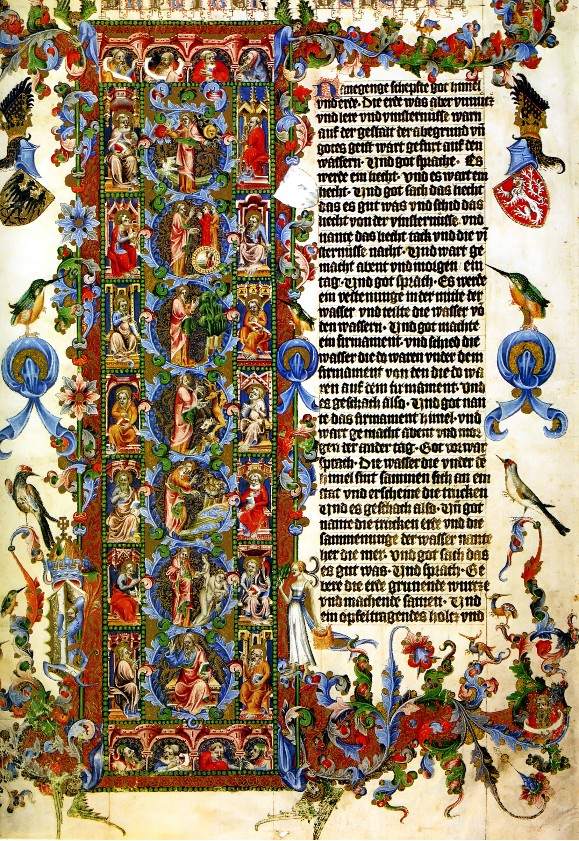
Even so, I have experienced a great deal of real joy in spending long hours staring at (digital) manuscripts, scouring my dad’s shelves of philosophical reference books for entries on Boethius, and passionately arguing about discussing early medieval scripture translations with extended family after a few drinks (my uncles were wrong, I was right). I am profoundly grateful that my relatives share enough appreciation for niche interests that I can insert a rogue connection to early medieval Spain into any given conversation without too many snarky remarks.
Pictured: evidence related to a rousing family discussion about whether Luther’s was the first translation of any scripture into German. Spoiler: it was not.
In trying to stretch my limits and expand my mind’s horizons over zoom, I have embarked on class projects far, far outside my comfort zone that have resulted in a great deal of anxiety, but an even greater repository of new and informative discoveries. My recent presentation on Boethius’ Contra Eutychen et Nestorium, for example, took me deep into an archive of St. John Henry Cardinal Newman’s works on early heresies. I had no idea the good man had written so much on the topic until a scramble the night before my presentation, but I can’t wait to dive in again (after I take some much needed ‘me time’ away from aforementioned Eutyches and Nestorius).
Another such outside-the-comfort-zone topic I find myself faced with is tracing manuscript transmission and reception of the Roman historian Florus, whose name I had heard of maybe once in my life before the topic landed in my lap, so to speak. I must admit the guy is featured in some extraordinarily aesthetically pleasing manuscripts (example). Having read quite a bit of Livy in undergrad and being thoroughly satiated thereof, I am also incredibly grateful to Florus for his project, condensing Livy’s history into manageable summaries – basically a sparknotes of Ab Urbe Condita. Who needs the original anyway?
On the more communal aspect of graduate school, I must admit the blessings were harder to find at first. I feel like an abandoned kitten without a mother cat to teach it how to properly be a cat sometimes. I don’t even know what grading paradigm my program uses (are there A+s? percentages? GPAs?) and I’m afraid to ask…and can’t pull aside a classmate in the hallway after class to do so.
However, though our interactions are limited to group chats, meme-sharing, and awkward small talk during the five minute mid-two-hour-zoom-class break, I am deeply impressed with the charity, enthusiasm, and supportiveness of my virtual grad school community. I’ve been offered notes for classes missed, I know what all the other M.A. students’ pets look like, and I feel confident in our capability to start a medieval lifestyle commune in the Canadian wilderness (once we actually make it to Canada!)
All in all, the zoom semester isn’t half so bad when I think on the ways it has stretched my brain and the possibilities for growth that remain in the next month that remains.

 Musings of a medievalist mama
Si quis facere potest, Tu potes. Magistra prima
LikeLike